
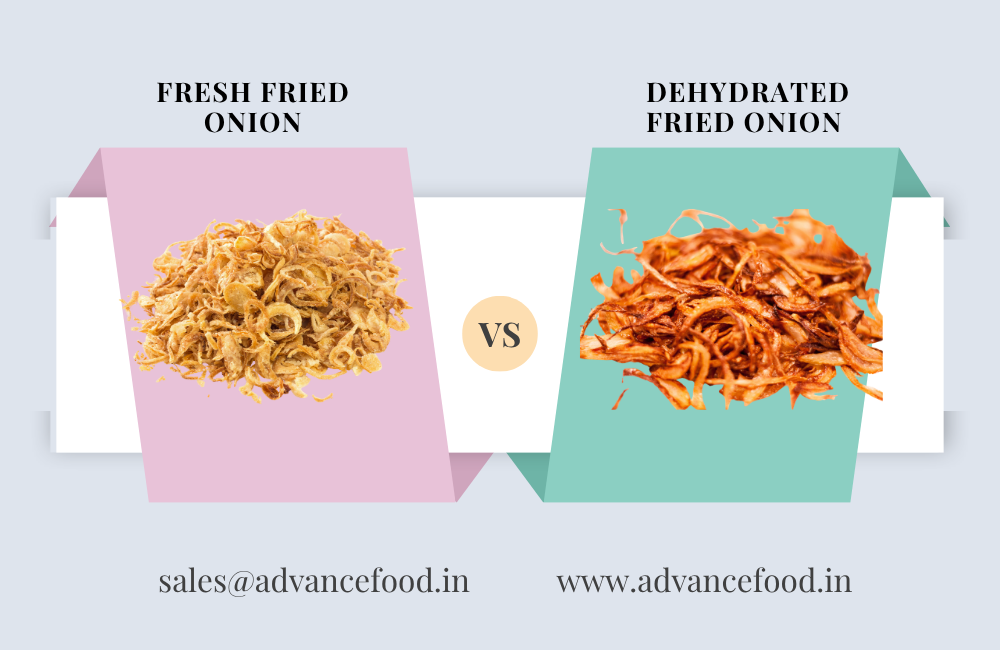
Fried onions - crispy, golden, and deeply aromatic are one of those ingredients that quietly determine the success or failure of a dish,whether it is biryani,a burger,or instant noodles. However, from a commercial perspective,onions freshly fried in a restaurant kitchen each morning and onions purchased in bulk from a food processor are two very different products. Below, we compare fresh versus dehydrated fried onions in terms of cost and shelf life, and explain why this distinction matters for large-scale buyers.
What sets them apart ?
Fresh fried onions are exactly what the name implies : onion Flakes fried in oil on-site, shortly before consumption,without any additional processing to extend their shelf life beyond a day or two. They are prized for the aroma and texture they offer straight from the pan, but they are inherently perishable products suited to a kitchen environment.
On the other hand, dehydrated fried onions are processed specifically for shelf stability: they are fried and then carefully dried to a low moisture content (usually less than 10%). This allows it to be stored,packaged, and transported without refrigeration avoiding the rapid quality loss associated with fresh fried onions.This format is found in instant noodle seasoning packets,snack coatings,ready-meal kits,and bulk supplies for the HORECA sector,precisely because it is designed to meet supply chain demands.
Shelf Life : A Key Practical Difference
This is where the comparison becomes truly critical.If left at room temperature in a kitchen,fresh fried onions begin to lose their crispness and develop an unpleasant taste within just a day or two due to oil oxidation ; oil-fried products are particularly prone to spoilage when exposed to both moisture and oxygen precisely the environment in which fresh fried onions exist.They must be used almost immediately or discarded, meaning that frying batches in the kitchen leads to waste and necessitates a constant cycle of fresh frying.
Dehydrated fried onions present a completely different scenario. When processed correctly and packaged in airtight,moisture-resistant conditions, they typically retain their quality for 12 to 18 months sometimes longer - because their low moisture content dramatically slows down both microbial spoilage and the oxidative rancidity that degrades frying oil over time.For any buyer operating on a production schedule whether a food manufacturer,a packaged snack brand or a distributor in the HORECA sector the difference between "use-within-a-day" and "stable for over a year" is not merely a matter of convenience. In fact, it is the fundamental reason why bulk sourcing is a viable option.
Cost : Where the real comparison gets interesting
If we look at the price per kilogram,dehydrated fried onions often appear more expensive than fried fresh onions on-site,as one is paying for the processing,drying and packaging required to ensure a long shelf life. However, that comparison overlooks the broader economic reality.
Fresh onions lose significant weight during frying due to moisture reduction and on-site frying entails hidden costs that rarely appear on the ingredient bill : the labor involved in chopping and frying the oil used (and often discarded) ; batches that spoil and get thrown away and the constant need to repeat the entire process daily rather than simply maintaining stock. Generally speaking,dehydrated onion products are said to achieve a conversion ratio of approximately 4:1 compared to fresh onions by weight ; this means a small amount of the dried product replaces a much larger quantity of fresh raw material. This ratio also directly impacts the economics of fried onion production, as it eliminates the need to purchase,prepare, and fry new batches almost every day. The absence of waste is the other side of the coin. Fresh fried onion that are not used within their short shelf life simply go to waste,whereas properly packaged dehydrated fried onion can be stored dry for months without the risk of spoilage; this means that buyers of bulk dehydrated fried onions do not pay for a product that ends up in the trash.
Consistency : A Cost Factor in Itself
This comparison involves a quality dimension that is easy to overlook. Freshly fried onions vary from batch to batch depending on who fries them,frying time,condition of the oil, and moisture content of the onions on any given day. Dehydrated fried onions, produced under controlled industrial conditions,offer consistent crunch,color and flavor intensity across batches. this is crucial for any manufacturer whose product must taste exactly the same,whether produced in January or July. Inconsistent fried onion quality is not merely a matter of taste,for a packaged food brand,it is a matter of repeat purchases and brand trust.
Where Fresh Still Wins
None of this implies that fresh fried onion have become obsolete.In high-end restaurants where the crunch and aroma of fresh fried onion (straight from the kitchen) are integral to the dining experience - no dehydrated product can fully replicate that "freshly made" taste and quality. Freshly fried onions hold a unique place in small-scale, immediate-consumption settings and in dishes prepared right before the customer's eyes; here, the cost of frying them upon receiving an order is justified by the superior experience they deliver.
Quick Comparison
| Fresh Fried Onion | Dehydrated Fried Onion | |
|---|---|---|
| Shelf life | 1–2 days, perishable | 12–18 months, shelf-stable |
| Storage needs | Immediate use, no stable storage | Dry, airtight, ambient storage |
| Batch consistency | Varies daily | Uniform, controlled |
| Hidden costs | Labor, oil waste, spoilage | Minimal — long usable life |
| Best for | On-site, immediate-use dishes | Bulk manufacturing, HORECA, packaged food |
Conclusion
Fresh fried onion and dehydrated fried onion do not truly compete for the same role: one is designed for the immediacy of on-site frying, while the other meets the demands of large-scale production, long supply chains and consistent year-round quality. When factors such as labor,oil wastage,product loss and batch-to-batch inconsistency are considered,the higher price per kilogram of dehydrated fried onions often results in lower actual costs for large-scale buyers an advantage further reinforced by a shelf life measured in months rather than days. For restaurants aiming to provide the specific experience of freshly fried onions,frying on-site remains the logical choice; however, for food manufacturers, snack producers, and HORECA buyers requiring a reliable, high-volume supply, dehydrated fried onions are almost always the more economical and lower-risk option.
FAQs
- What is the difference between fresh fried onion and dehydrated fried onion ?
Fresh fried onion is prepared by frying freshly cut onions, while dehydrated fried onion is processed to reduce moisture and improve storage stability. - Which is more cost-effective: fresh fried onion or dehydrated fried onion ?
The cost depends on raw materials, oil, processing, storage, transportation, and wastage. Compare the total cost per usable kilogram rather than purchase price alone. - What is the shelf life of dehydrated fried onion ?
Shelf life depends on processing, residual moisture, oil content, packaging, and storage conditions. Always follow the supplier's declared shelf life. - How should dehydrated fried onion be stored ?
Store it in sealed, food-grade packaging in a cool, dry place away from direct sunlight and moisture. - Where can I find a dehydrated fried onion supplier in Gujarat ?
You can contact food ingredient suppliers in Gujarat for product specifications, samples, and bulk purchasing options. - Who uses dehydrated fried onion in food manufacturing ?
Biryani manufacturers, snack producers, curry manufacturers, seasoning companies, and ready-to-eat food businesses use fried onion as an ingredient. - Is dehydrated fried onion suitable for hotels and restaurants ?
Yes, it can help food-service businesses simplify preparation and reduce the time required for frying onions in commercial kitchens. - Is dehydrated fried onion available in bulk packaging ?
Bulk suppliers may offer 1 kg, 5 kg, and 25 kg packs, depending on product availability and packaging requirements. - How does dehydrated fried onion help reduce food preparation costs ?
It can reduce preparation labour, frying time, oil handling, and kitchen wastage. Actual savings depend on the recipe and purchase price. - How can I buy export-quality dehydrated fried onion from India ?
Contact a reliable Indian supplier to confirm product specifications, oil content, packaging, shelf life, quality documents, minimum order quantity, and export requirements.