
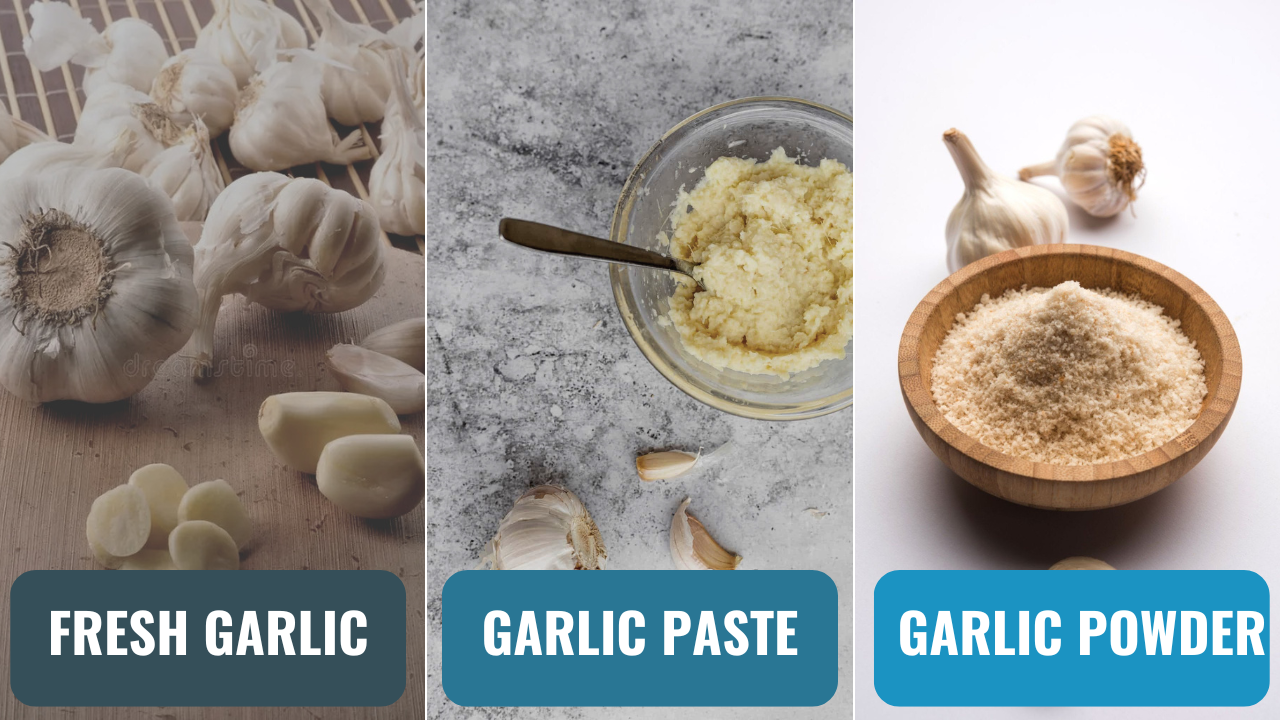
If you ask a chef which garlic is best, they will answer based on flavor. If you ask a purchasing manager, they will answer based on the price per kilogram. Neither of these answers tells you the actual cost incurred when adding garlic to a dish,a marinade or a seasoning blend.That figure the cost per use is what truly matters; and this is precisely where fresh garlic,garlic paste and garlic powder differ far more than most buyers expect.
This article analyzes the true cost of each format, accounting for factors that never appear on an invoice: waste from peeling,spoilage,labor and storage. If you manage a restaurant kitchen,a catering service or a food production line, this information will help you determine which format deserves a place in your pantry.
Why Price Per Kilogram Is Not the Right Metric
On a price list, fresh garlic appears to be the most economical option. The cost of a kilogram of whole garlic bulbs is significantly lower than that of a kilogram of dehydrated garlic powder a fact that makes it tempting to end the comparison right there.However, a kilogram of garlic bulbs is not equivalent to a kilogram of usable garlic.Dried peels,roots, and cloves that have sprouted,dried out or softened lose weight. Conversely, one kilogram of garlic powder is not equivalent to one kilogram of fresh garlic.A fresh garlic clove consists mostly of water approximately 60% to 65% which is almost entirely removed during the dehydration process.Therefore, a small amount of dehydrated garlic powder provides as much flavor as a much larger quantity of fresh garlic.
To make a fair comparison, it is necessary to use a common unit of measurement. In this article,that unit is "the equivalent of one garlic clove" the amount of each product required to achieve a flavor comparable to that of a medium-sized fresh garlic clove.
General Conversion Rules
In the kitchen, a common conversion is that one medium-sized clove of garlic is roughly equivalent to 1/8 teaspoon of garlic powder weighing approximately 0.4 grams. In the case of garlic paste,one teaspoon (about 5 grams) is generally considered equal to one clove of garlic.
However, these figures are not absolute, so there are a few points to keep in mind
Garlic varieties differ. Smaller cloves - often found in many Indian varieties tend to have a milder flavor compared to larger cloves. Some cookbooks and manufacturers suggest different ratios for Garlic powder ; therefore, start with 1/8 teaspoon and adjust the amount as needed after tasting the result.Garlic powder that has been stored for a long time may lose its potency, so you might need to add 10–25% more. Furthermore, the fineness of the powder (particle size) influences how quickly the flavor is released; consequently,in quick-cooking dishes like chutneys or sauces,a finer powder may deliver a more intense flavor compared to a coarser one.
A Practical Example of Cost Calculation
The price of fresh garlic, in particular, tends to fluctuate significantly; therefore, I will present this method based on specific assumptions. You may adjust these figures according to the current prices in your area.The key aspect here is the calculation method (the framework) rather than the specific monetary figure.
Assumptions (for the purpose of this illustration):
- Fresh garlic (whole bulbs) : ₹150/kg; approximately 20% is lost during peeling and cleaning, and another ~10% is lost due to sprouting or spoilage.
Average weight of a single peeled clove: Approximately 4 grams.
- Garlic paste: ₹250/kg ; approximately 5% of the paste may spoil or go to waste after the container is opened.
- Dried garlic powder (wholesale): ₹500/kg ; there is virtually zero wastage if stored correctly.
Cost calculation for 1,000 garlic cloves (roughly the weekly consumption of a small, busy kitchen).
Fresh garlic : 1,000 cloves, weighing 4 grams each, resulting in a total of 4 kg of peeled garlic. Accounting for a 20% loss during peeling, approximately 5 kg of whole garlic will be required. This costs ₹750, which rises to around ₹825 when potential wastage is factored in.
Garlic paste : 1,000 spoonfuls (5 grams each), totaling 5 kg of paste. At a price of ₹250 per kg, the total cost is ₹1,250 or approximately ₹1,313 when accounting for wastage that occurs when opening the containers.
Garlic powder : Equivalent to 1,000 garlic cloves (0.4 grams each), totaling 400 grams. At a price of ₹500 per kg, the total cost comes to approximately ₹200.\
| Fresh garlic | Garlic paste | Garlic powder | |
|---|---|---|---|
| Material needed per 1,000 clove equivalents | ~5 kg bulbs | ~5 kg paste | ~400 g |
| Ingredient cost (with wastage) | ~₹825 | ~₹1,313 | ~₹200 |
| Peeling and chopping labour | High | None | None |
| Approx. cost per clove equivalent | ~₹0.83 | ~₹1.31 | ~₹0.20 |
Based on these assumptions, the 'cost-per-use' of garlic powder is approximately one-fourth the cost of fresh garlic and about one-sixth the cost of garlic paste. This does not even account for labor costs. Peeling and chopping five kilograms of garlic bulbs by hand easily takes about two hours every week; while this time may not appear in the accounting books, it still carries a value (or cost).
When is fresh garlic more economical (cheaper) ?
Fresh garlic is not always the most expensive option. Its prices fluctuate, and when garlic is cheap, the cost gap narrows. According to the assumptions mentioned above, the cost of fresh garlic would only be on par with garlic powder if the price of garlic dropped to approximately 35–40 rupees per kilogram and this is without even considering labor costs ! In reality, this only happens when the market supply of garlic significantly exceeds demand, and such a situation typically lasts for a very short period.
The opposite scenario can also occur. When the price of garlic spikes significantly for instance,reaching 300 rupees per kilogram the cost of using fresh garlic effectively doubles. In contrast, the 'cost-per-use' of garlic powder which is derived from the same crop remains virtually unchanged, primarily because the quantity required for any given dish is very small. For businesses that require stability in their raw material costs, this characteristic of garlic powder offers a major advantage. In fact, this is precisely why garlic powder has become an indispensable ingredient in the kitchens of the HORECA sector (Hotels, Restaurants, and Cafes) as well as in companies that manufacture packaged food products.
Shelf Life and Spoilage : A Hidden Cost
Cost-per-use essentially encompasses the price of the product plus the cost associated with spoilage and the extent of spoilage depends directly on the item's shelf life (how long it remains usable).
- Fresh Garlic : Whole bulbs of garlic, when stored in a cool,dry and well-ventilated area, generally remain in good condition for several months. However, once peeled,they last only a few days or at most a week or two - even when kept in a refrigerator ! For this very reason,professional kitchens often prefer to peel garlic daily or alternatively,pay a premium to purchase pre-peeled garlic.Every clove that sprouts or softens represents money ending up in the trash.
- Garlic paste : While convenient,garlic paste is a moist product.It typically contains salt,oil or an acid as a preservative ; once the jar or container is opened,its shelf life is limited often lasting only a few weeks in the refrigerator,depending on the specific formulation.One must always follow the instructions on the label.A note on safety : Garlic prepared at home and stored in oil at room temperature carries a known risk of botulism; therefore,any garlic-in-oil product requires proper acidification or refrigeration. This is another reason why professional kitchens prefer using standardized,tested products rather than improvised preparations.
- Garlic powder : When processed correctly and packed in a moisture-resistant container, dehydrated garlic powder generally retains its quality for 12 to 24 months ; some sources suggest that,in the case of sealed commercial packaging, this period can extend up to three years.Unlike fresh garlic, it does not spoil. Garlic gradually loses its aroma, so the fundamental rule for storage is simple: it should be kept in an airtight container, in a cool, dry place, and protected from light. Anyone who has observed how quickly garlic powder clumps in a humid kitchen will understand why controlling moisture is not optional.
Flavor and Efficiency : What Is Lost and What Is Gained
Cost isn't everything ; thinking otherwise often results in lackluster dishes in the kitchen.
Fresh garlic possesses a vibrant,pungent and complex character.Crushing the cloves triggers a chemical reaction that produces allicin - the compound responsible for the characteristic sharp bite of raw garlic. Furthermore, when sautéed, it caramelizes and develops notes reminiscent of nuts. For these reasons, fresh garlic is the ideal choice for finishing touches,raw preparations such as chutneys or dressings and any recipe where garlic takes center stage.
Garlic paste falls somewhere in the middle. It is easy to measure, distributes evenly within sauces and marinades, and is widely used in Indian cuisine, where a smooth-textured garlic base is often desired. The downside is that it contains added water and preservatives; in preparations relying on dry ingredients, this moisture can be problematic.
Dehydrated garlic powder offers a milder,more consistent flavor profile.It is an ideal choice for dry rubs,spice blends,instant soups,snack coatings,sauces and ready-to-eat meals applications where the moisture content of fresh garlic could cause clumping,spoilage or a lack of uniformity. It also disperses evenly,which is why food manufacturers include it in their formulations. A practical tip from professionals who use it: add it earlier in the process than you would fresh garlic and mix it with a little liquid or oil to help it "wake up". it needs to be rehydrated to release its full flavor.
Consistency : An Invaluable Asset
Fresh garlic varies depending on the season,variety and storage conditions. A batch of freshly harvested garlic might have a significantly more intense flavor than one from the previous month.For restaurant chains or brands selling the same product nationwide, such variations can lead to customer complaints and the need to constantly adjust recipes.
When garlic powder is sourced from a reliable manufacturer,it is produced according to precise technical specifications : moisture content,particle size,color and flavor intensity are monitored and analyzed on a batch-by-batch basis.This ensures predictable results during cooking.For this reason, rather than being satisfied with a general description,professional buyers demand a 'Certificate of Analysis' and specific details regarding the production batch.In the case of garlic powder intended for export,the requirements are even more stringent : they include microbiological analysis,compliance with limits on pesticide residues (in accordance with the regulations of the destination market), and moisture-resistant packaging suitable for long-distance transport.
Who should use what ?
For restaurants and cloud kitchens,a hybrid approach is generally best.Use garlic powder for dressings,marinades,Tandoori-style spice blends and base sauces prepared in large batches,while keeping a supply of fresh garlic on hand for finishing touches and soffritto (sautéed aromatics). Many professional kitchens use both,which results in significant cost savings when preparing food in large volumes.
Catering services and large-scale institutional kitchens benefit most from using garlic powder or garlic paste; because they cook in such large quantities, they cannot afford to spend hours peeling garlic. At this scale, labor costs typically outweigh the price difference between the ingredients.
Food manufacturers and producers of spice blends should primarily opt for dehydrated garlic powder or depending on the specific application,granules or flakes. Consistency,shelf stability and low moisture content are essential requirements for any production line.
For retail and home use, both options work well. Since the cost difference is negligible when working with small quantities,personal taste preferences and convenience become the deciding factors.Practical Ways to Reduce Costs Without Sacrificing Garlic Flavor
Base your purchasing decisions on technical specifications rather than brand names. Two powdered products may differ in price due to variations in purity, intensity, or particle size; therefore, compare the specifications for each batch instead of focusing solely on the price. Select packaging formats that align with your production volume to avoid open bags that could absorb moisture. Store garlic powder in an airtight container, away from steam and heat. Use fresh garlic for the finishing touches and garlic powder as a base for your preparations—this ensures that you only use the more expensive form when its flavor can truly shine. Additionally, calculate the actual cost of garlic per dish over the course of a month; in most kitchens, this figure turns out to be different from the initial estimate.
Conclusion
If you look only at the purchase price, fresh garlic appears to be the most economical option; garlic paste is generally considered to carry a premium for the convenience it offers; and garlic powder is often perceived as an expensive, specialized ingredient. However, when you analyze the cost per use, the picture changes. Once you account for waste—such as peels and spoilage as well as labor costs and shelf life, dehydrated garlic powder is generally the most economical option. Garlic paste is the most expensive, but it offers the greatest time savings; fresh garlic falls somewhere in between, providing an unparalleled flavor. The most efficient kitchens and manufacturers do not rely on just one option. Each form serves a specific purpose: garlic powder adds volume and consistency; garlic paste offers convenience; and fresh garlic is ideal for moments when you want its flavor to truly stand out. By calculating the figures based on your own specific costs, the right combination usually becomes clear.
At Advance Food, Mahuva, Gujarat, supplies food ingredients including dehydrated garlic and garlic powder for commercial buyers. Restaurants,food processors,masala manufacturers,wholesalers and seasoning businesses can enquire about product specifications,packaging options,sample availability and bulk pricing.
FAQs
- Is garlic powder cheaper than fresh garlic ?
It can be cheaper per recipe when the required dose is small and preparation labour and waste are included. Compare actual usable quantities before deciding. - Is garlic paste cheaper than garlic powder ?
Not necessarily. Garlic paste may have a lower price per kilogram, but it contains moisture and may require refrigerated storage after opening. - Can restaurants replace fresh garlic with garlic powder ?
Yes, in many seasonings, sauces, marinades, and standardised recipes. Adjust the quantity and test the flavour before switching completely. - Which garlic product is best for bulk food manufacturing ?
Garlic powder is often practical for dry blends and seasonings, while paste and fresh garlic may be preferable for wet preparations and recipes requiring fresh garlic texture. - How can food manufacturers reduce garlic costs ?
Compare the cost per finished batch, including ingredient dosage, preparation labour, waste, storage, and consistency,not just the purchase price per kilogram.