
Ask two buyers what "onion powder" is,and you will encounter two different expectations regarding texture.One person might be looking for a powder with coarse granules that feels slightly firm or gritty when pressed between the fingers,while another might want a powder that dissolves completely in liquid.The difference between the two usually comes down to one factor : Mesh Size - If you have ever been confused by a specification sheet listing 40,60,80 or 100 mesh and wondered what that actually means for your recipe,here is a detailed explanation.
What does mesh size actually mean?
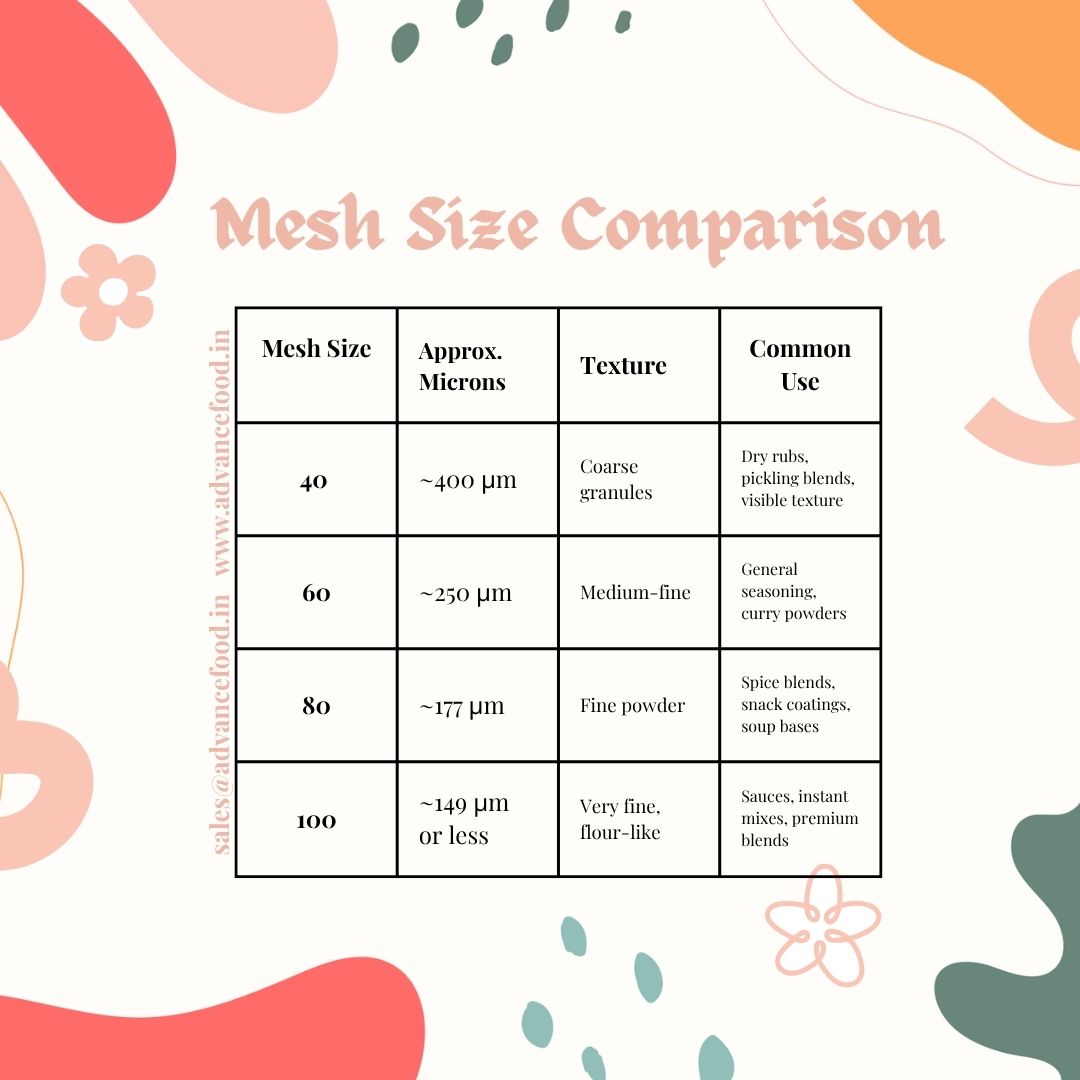
Mesh size refers to the number of holes per linear inch in the sieve used to categorize the powder after grinding. A 40-mesh sieve has 40 holes per inch,whereas a 100-mesh sieve has 100 holes within the same span.The more holes there are, the smaller the size of each individual hole; therefore,the higher the mesh number,the finer and smaller the particles. In terms of approximate micron size: 40 mesh is roughly 400 microns; 60 mesh is roughly 250 microns; 80 mesh is roughly 177 microns; and 100 mesh is roughly 149 microns.Thus, the first thing to remember about mesh size for dried onion powder is that the number does not measure the size of the powder particles themselves; rather, it indicates the number of holes in the sieve through which the powder has passed.
40 Mesh : Coarse-grained and slow-dissolving
- Onion particles in the 40-mesh range resemble coarse granules more than a fine powder. The individual particles are visible, and instead of dissolving instantly, the product provides some texture and a bit of chewiness. This size is typically used in 'dry rubs' (dry spice blends),pickling spices,curry powder,sambhar masala and products where visible texture is desired - such as seasonings where you want to see small onion flakes rather than achieving a uniform color in the final result. Due to their larger particle size,40-mesh dehydrated onion rehydrate and release their flavor more slowly compared to finer varieties.While this can be an advantage in dishes cooked over low heat,it may be a disadvantage in applications like quick sauces or beverage mixes where immediate flavor integration is required.
60-Mesh : The Intermediate Option
- 60-mesh falls between the granular form and fine powder : it is fine enough to blend well into dry mixes,ready to mix,ready to eat products,yet not as smooth or quick-dissolving as ultra-fine varieties.It is a common choice for general-purpose spice blends,curry powders,and snack coatings; the medium texture works effectively here while avoiding the additional costs and processing time associated with 100-mesh or finer grinds.
- Many suppliers of dehydrated garlic and onion powders offer the 40–60 mesh range as a single commercial grade, as the practical difference in food manufacturing is negligible and it provides manufacturers with greater flexibility in usage.
80-Mesh : Fine powder for uniform blending
- At the 80-mesh level, the product falls squarely into the fine powder category. The particles are small enough to disperse evenly throughout a spice blend without clumping or separating; this is crucial for pre-mixed spice packets,seasoning blends, and dry soup bases, where consistent flavor intensity in every spoonful is essential. It is one of the most sought-after mesh sizes among industrial (B2B) buyers because it strikes a practical balance between fineness and cost: achieving a finer grind requires more time and energy,making 80-mesh the sweet spot between performance and price.
- This is precisely why the 80-to-100 mesh range is so common in the market: it meets the majority of the food industry's standard requirements without the costs associated with ultra-fine grinding.
100-Mesh and finer: Smooth texture, rapid solubility & premium quality
- At the 100-mesh level and above, the dried onion powder achieves true fineness,taking on a flour-like texture rather than that of granular spice particles. Particles of this size dissolve almost instantly in liquids—blending easily into sauces, dressings, and powdered drink mixes—without leaving any gritty texture or noticeable particles in the mouth during consumption. This is crucial for products like instant soups, smooth sauces, and high-quality spice blends, where the product's texture is subjected to rigorous scrutiny. Consequently, buyers seeking a highly refined, premium-quality end product often specify a 100-mesh or even 120-mesh grade.
However, this increases processing costs and can sometimes lead to a slight reduction in aroma.
How to Choose the Right Mesh Size for Your Product
Selecting the appropriate mesh size depends primarily on three factors : the required rate of flavor release,whether the final product demands a completely uniform appearance or can accommodate visible texture (granular structure),and the actual capacity of your processing line.There is a significant difference between the requirements for a dry spice sachet and a liquid sauce base,even if both are labeled simply as onion powder.It is also important to note that mesh size is not defined by a single specific figure ; most commercial specifications are stated as a range (e.g., 40–60 or 80–100 mesh) because the sieving process naturally yields a distribution of particle sizes rather than a single, uniform size. If your product is sensitive to texture or flow characteristics, the best approach is to request a sample with the specific mesh range from the supplier before placing a bulk order.
Conclusion
Mesh size might seem like a minor technical detail on a specification sheet,but it quietly determines how the dried onion powder will behave in the final product influencing factors such as the rate of flavor release, blend uniformity, and whether the resulting texture feels coarse and rustic or smooth and refined. Whether you require a 40-mesh size for a coarse dry rub, an 80-mesh size for a balanced spice blend, or a 100-mesh size for a silky sauce base, selecting the right mesh size is just as crucial as choosing the correct onion variety or moisture content. For any buyer comparing dehydrated onion powder mesh sizes, the wisest strategy is simple: determine the specific texture and flavor profile required for the final product, and then identify the mesh size needed to achieve it.\
FAQs
- What is dehydrated onion powder mesh size ?
It indicates the fineness of onion powder particles measured using sieves. - What is 40 mesh onion powder ?
40 mesh onion powder is a relatively coarse grade used in food processing and seasoning blends. - What is 60 mesh onion powder ?
60 mesh onion powder offers a medium-fine texture suitable for spice blends and food manufacturing. - What is 80 mesh onion powder ?
80 mesh onion powder is a fine grade commonly used in seasonings, sauces, and soup mixes. - What is 100 mesh onion powder ?
100 mesh onion powder is a finer grade suitable for applications requiring a smooth texture. - Which mesh size is best for onion powder ?
80–100 mesh is often preferred for fine seasonings, while the ideal grade depends on the application. - What is the difference between onion powder and onion granules ?
Onion powder has finer particles, while onion granules have a coarser texture. - How many microns is 100 mesh onion powder ?
A standard 100-mesh sieve has an opening of approximately 150 microns. - What specifications should bulk onion powder buyers check ?
Check mesh size, moisture content, colour, flavour, microbiological quality, and packaging. - Where can I buy bulk dehydrated onion powder in India ?
Contact a reliable onion powder manufacturer or supplier in India for available grades, specifications, samples, and bulk pricing.