
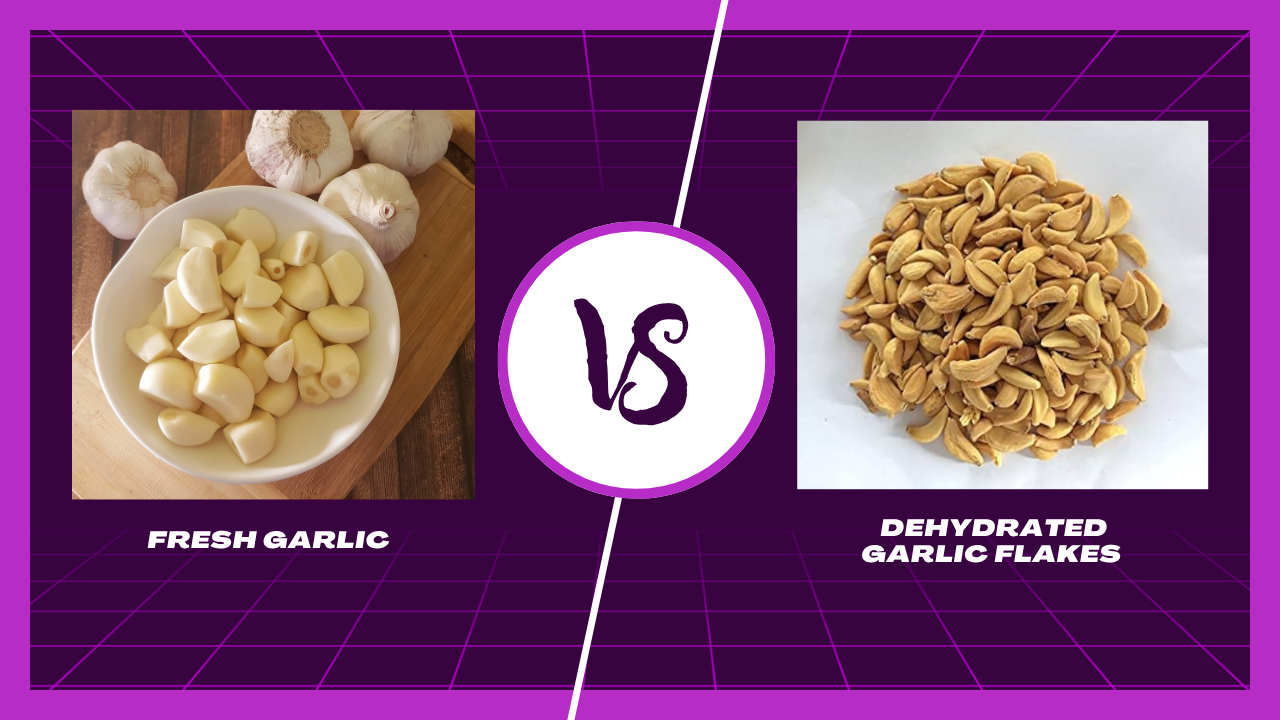
Every food manufacturer that uses garlic eventually ends up creating a similar spreadsheet (cost analysis sheet).Fresh garlic appears cheaper on a per-kilogram basis, whereas dehydrated garlic flakes seem expensive.Someone from the purchase department might argue that fresh garlic is the more economical option,while someone from the production department might point out that garlic flakes are easier to use.This discussion often goes in circles because the figures being compared do not actually represent equivalent items.
The purpose of this article is to clarify this subject properly.It analyzes the actual cost of each option within the context of the production process,demonstrates how the results shift based on key factors and sheds light on hidden costs that are typically overlooked during procurement comparisons.In short,the difference between the two is much smaller than commonly believed and determining which option is superior depends on three measurable factors.
Why can comparisons based on weight (per kg) be misleading ?
One kilogram of fresh garlic and one kilogram of dehydrated garlic flakes are not the same material.Fresh garlic contains approximately 60% to 65% water.In contrast, dehydrated garlic flakes have a very low moisture content typically around 6% to 8%. During the drying process, the garlic content becomes concentrated ; therefore, one kilogram of dried garlic flakes is equivalent to several kilograms of fresh garlic.
Furthermore, a whole bulb of garlic cannot be utilized in its entirety.Weight is lost due to the peel,the root end and any cloves that have sprouted or softened.Consequently,the correct unit of measurement is not the "Kg purchased" but rather the cost per kilogram of usable garlic that actually reaches the production line a metric that should be expressed using a consistent standard.In this article,we will use one kilogram of peeled fresh garlic as our benchmark.
Equivalence factor : The figure upon which everything hinges.
The most critical factor in this comparison is determining how many kilograms of peeled fresh garlic can be replaced by one kilogram of dehydrated garlic flakes. It is important to acknowledge from the outset that there is no single fixed or universally accepted figure for this.
Based solely on dry matter content, one kilogram of dehydrated garlic flakes is roughly equivalent to 2.5 to 3 kilograms of peeled fresh garlic.In this industry, a common rule of thumb suggests a very high ratio up to 5:1. On the other hand,a supplier of fresh garlic has presented a sensory evaluation claiming that, based on taste,the actual equivalence is slightly less than 2:1; this implies that the cost of using fresh garlic is roughly comparable to that of using dehydrated garlic.Since this claim comes from a company that sells fresh garlic, it should be viewed with appropriate caution ; nevertheless,it highlights an important point : the conclusion can change entirely depending on the ratio you assume and the only reliable answer is one derived from measurements of the specific product.
Therefore, conduct a practical test : Prepare your dish using fresh garlic and then experiment by adjusting the quantity of garlic flakes.Continue testing until you find a quantity at which a panel of experts cannot distinguish between that version of the dish and the one made with fresh garlic.That will be your actual ratio.
Cost Comparison : Fresh Garlic vs. Dehydrated Garlic Flakes
Using your prices fresh garlic at ₹100/kg and dehydrated garlic flakes at ₹200/kg ,here is the cost calculation for food processing and manufacturing.
1 . Cost assumptions
| Particulars | Cost / Loss |
|---|---|
| Fresh garlic bulbs | ₹100/kg |
| Peeling and trimming loss | 20% |
| Spoilage loss | 5% |
| Fresh garlic handling cost | ₹20/kg peeled garlic |
| Dehydrated garlic flakes | ₹200/kg |
| Flake wastage | 1% |
| Flake handling cost | ₹3/kg |
Fresh garlic cost calculation
To obtain 1 kg of peeled garlic:
- Required garlic bulbs, including 20% peeling loss : 1/0.80 = 1.25 kg
- Including 5% spoilage allowance : 1.25 x 1.05 = 1.3125 kg
- Raw garlic cost : (1.3125 x ₹100 = ₹131.25)
- Handling cost : ₹20
Total fresh garlic cost = ₹151.25 per kg of peeled equivalent.
3. Dehydrated garlic flakes cost calculation
- Flake purchase price: ₹200/kg
- Wastage allowance (1%): ₹2
- Handling cost: ₹3
Total dehydrated garlic flakes cost = ₹205 per kg of flakes.
The final equivalent cost depends on how much fresh peeled garlic 1 kg of flakes replaces.
| Fresh garlic equivalence ratio | Flakes cost per kg of fresh equivalent | Savings vs. fresh garlic |
|---|---|---|
| 2:1 | ₹102.50 | ₹48.75/kg (32.2%) |
| 3:1 | ₹68.33 | ₹82.92/kg (54.8%) |
| 5:1 | ₹41.00 | ₹110.25/kg (72.9%) |
Assumption : the ratios mean 1 kg of dehydrated flakes replaces 2,3 or 5 kg of fresh peeled garlic,respectively. Actual replacement depends on moisture content,product specifications and the recipe.
4.Monthly savings for 1,000 kg of fresh peeled garlic equivalent
| Equivalence ratio | Fresh garlic cost | Flakes cost | Monthly savings |
| 2:1 | ₹151,250 | ₹102,500 | ₹48,750 |
| 3:1 | ₹151,250 | ₹68,333 | ₹82,917 |
| 5:1 | ₹151,250 | ₹41,000 | ₹110,250 |
At these assumed prices, dehydrated garlic flakes cost ₹200/kg, compared with fresh garlic bulbs at ₹100/kg.Dehydrated flakes may offer substantial savings when their concentrated flavour and solids allow them to replace sufficient fresh peeled garlic.
Before making a purchasing decision, conduct a small production trial to confirm the actual replacement ratio,flavour,texture and yield. The figures above exclude any additional costs or recipe adjustments not listed in the assumptions.
An important clarification : the price of pieces cannot be arbitrarily low, because the cost of the raw material sets a minimum threshold. Since producing one kilogram of pieces requires several kilograms of whole bulbs—accounting for losses during peeling and the drying process—the price of the pieces tends to track the price of fresh garlic, albeit with a certain time lag.
Hidden costs that tip the scales
The table above accounts for the cost of ingredients and specific handling tasks. However, in an actual production facility, there are other factors associated with using fresh garlic that are rarely taken into consideration:
- Equipment for peeling and processing : Processing fresh garlic peeling,crushing or chopping requires specialized machinery,as well as systems for washing and sanitizing. This entails capital expenditure,maintenance costs and the potential for operational downtime.Furthermore, waste materials such as skins and trimmings must be managed, along with the water used for washing.
- Labor : Even with the use of machinery, processing fresh garlic requires a significant amount of manual labor, particularly for quality sorting and the removal of damaged cloves.
- Cold Storage and Shelf Life : Whole bulbs can be stored for several months under appropriate conditions ; in contrast,peeled or crushed garlic spoils rapidly and requires refrigeration. Meanwhile, dried and sealed garlic products typically have a shelf life of 12 to 24 months.These differences impact inventory management, order frequency and potential losses from discarded products.
- Odor and Cleaning : The pungent odor of garlic presents an operational challenge. It permeates equipment and facilities,potentially affecting other products processed on the same production lines; consequently, this necessitates additional cleaning between production cycles.
- Seasonal price volatility : The prices of fresh garlic can vary significantly from one season to another. Consequently, a budget prepared in March may prove to be completely inaccurate by September. Dried garlic flakes do not entirely eliminate this volatility, as their prices also tend to follow the price trends of fresh garlic; however, for products that can be stored for long periods,contractually fixed prices provide a predictable framework for planning an advantage that is not possible with fresh garlic.
- Consistency : The intensity of flavor varies based on the harvest,variety and storage duration. A manufacturer requiring a consistent flavor profile across every batch must actively manage this variability when using fresh garlic. Conversely, a supplier of garlic pieces who adheres to technical specifications and provides analysis reports for each batch reduces the workload for the manufacturer's quality control team.
Food Safety Considerations
Both forms entail food safety responsibilities,though the nature of these responsibilities differs.
Fresh garlic comes from the soil ; therefore, it requires proper washing and depending on the final product a pathogen-elimination process or acidification. As a low-acid ingredient,fresh garlic especially when mixed with oil poses a known risk of botulism if not properly acidified or refrigerated.Consequently, manufacturers using fresh garlic in oil-based or low-acid products must implement validated control measures.
Dehydrated garlic Flakes are shelf-stable, but being a dried product does not mean they are free from risks.Spices and dried seasonings are considered low-moisture products that may harbor Salmonella ; Therefore, it is advisable to source these ingredients from suppliers who guarantee a validated microbial reduction process and provide a Certificate of Analysis for each batch,covering moisture levels and microbiological limits.
Look for suppliers who hold HACCP (or equivalent) certification and utilize metal detection systems during their production process.Our guide on selecting suppliers for dehydrated onions covers these points in detail principles that largely apply to garlic as well.
Flavor Profile and Suitability for Processing
Cost is not the only factor to consider : Fresh garlic offers a vibrant,more intense and complex flavor - crushing the cloves triggers chemical reactions that produce the compounds responsible for the characteristic pungency of raw garlic. In contrast, garlic pieces offer a more balanced profile,similar to cooked garlic.Neither option is inherently better than the other ; the choice depends entirely on the specific product.
Garlic flakes are ideal for dry seasoning blends,instant soups,ready-made meals,sauces,snack seasonings and pickles applications where stability at room temperature and product uniformity are more important than a fresh or raw flavor profile.The flakes rehydrate upon contact with liquids ; therefore,this rehydration time must be taken into account during the production process.Furthermore, temperature management is crucial : dehydrated garlic can burn and become bitter if exposed to excessive heat ; consequently,it should be added at the appropriate stage and in the presence of sufficient moisture.
Using fresh garlic is advantageous when fresh quality serves as a key selling point for instance,in refrigerated sauces,spreads or premium products featuring authentic garlic or when production volume is sufficiently high to justify investments in specialized equipment and a cold chain. Many manufacturers choose to combine both : using fresh garlic for products where its presence is a defining characteristic and garlic pieces or powder for others.If you are interested in exploring forms other than flakes,our previous analysis covering garlic powder,garlic paste and fresh garlic examines this same logic in the context of home cooking.
Questions to Ask a Supplier of Dehydrated Garlic Flakes
If the data suggests that garlic pieces are worth considering, here are the key questions you should ask :
What is the moisture content, and how is it measured ?
What are the microbiological limits and what process is used to verify them ?
What are the size and color specifications for the garlic flakes and how consistent are they from one batch to another ?
Does the garlic come from a specific region and how is the quality of the raw material controlled ? For example, Gujarat is a major region in India for garlic cultivation and processing and suppliers from that area typically possess extensive experience with this product.
What certifications do they hold and what aspects do these certifications cover ?
What type of packaging is used and how does it protect the product from moisture during transport and storage ?
Can they provide samples from different batches, accompanied by a Certificate of Analysis for each shipment ?\
A Practical Framework for Decision-Making
- Determine your own equivalence ratio (consistency benchmark) by conducting small-scale testing using your actual production process.
- Calculate the true cost of fresh garlic,accounting for losses due to peeling,spoilage, labor,cold storage and waste management.
- Request a written quote for garlic flakes based on specified requirements and analyze it using a break-even chart.
- Consider factors such as inventory flexibility,price stability and consistency requirements.
- Conduct a pilot test of your chosen option on a single production line before implementing large-scale changes.
Conclusion
The costs of dehydrated garlic flakes and fresh garlic are more similar than the per-kilogram price figures might suggest.The most suitable option depends on three measurable variables : your equivalent ratio,the price difference between whole bulbs and flakes and the actual costs involved in handling fresh garlic.Given a moderate equivalent ratio and a reasonable price for garlic flakes,this option often proves more advantageous when accounting for losses from peeling,spoilage,labor and cold storage. Conversely, if the equivalent ratio is low or the price of flakes is high, fresh garlic may be more cost-effective at least on paper.What flakes consistently offer is stability : a long shelf life,supply reliability and uniform specifications across different batches.For food manufacturers,this is often just as important as the unit price ; therefore,the most prudent approach is to perform calculations based on their own data,test the product on their own production lines and rather than selecting a single option for the entire plant choose the most suitable option for each individual production line.
FAQs
- What is the difference between dehydrated garlic flakes and fresh garlic ?
Dehydrated garlic flakes have reduced moisture and a longer storage life, while fresh garlic contains more water and requires peeling and preparation. - Are dehydrated garlic flakes more cost-effective than fresh garlic ?
They can be more cost-effective when labour,peeling losses,storage,waste and processing costs are included in the comparison. - How do I calculate the cost of dehydrated garlic flakes versus fresh garlic ?
Compare the purchase cost per usable kilogram, including peeling loss,labour,storage,wastage and any additional processing expenses. - How much fresh garlic is required to produce 1 kg of dehydrated garlic flakes ?
The quantity depends on the garlic variety,initial moisture,peeling losses and final moisture content. Ask your supplier for the product's processing yield data. - Why do food manufacturers use dehydrated garlic flakes ?
They offer convenient handling,consistent portioning,reduced preparation work and easier storage for commercial food production. - What is the shelf life of dehydrated garlic flakes ?
Shelf life depends on processing,moisture content,packaging and storage conditions. Follow the supplier's declared shelf life. - Are dehydrated garlic flakes suitable for spice manufacturers ?
Yes, they can be used in spice blends,seasoning mixes,marinades,instant foods and other commercial formulations. - Can dehydrated garlic flakes replace fresh garlic in food processing ?
They can replace fresh garlic in many formulations, but the required quantity and preparation method depend on the recipe and desired flavour. - How do dehydrated garlic flakes reduce labour costs ?
They reduce or eliminate the need for peeling,slicing and drying fresh garlic at the manufacturing facility. - What factors affect the wholesale price of dehydrated garlic flakes in India ?
Prices depend on garlic quality,flake size,moisture content,processing method,packaging,order quantity and market conditions. - How should dehydrated garlic flakes be stored ?
Store them in sealed, moisture-resistant packaging in a cool,dry environment away from direct sunlight and strong odours. - Are dehydrated garlic flakes suitable for restaurants and HoReCa businesses ?
Yes, they offer convenient ingredient handling for hotels,restaurants,caterers and commercial kitchens. - What quality specifications should food manufacturers check when buying dehydrated garlic flakes ?
Check moisture content,colour,aroma,flake size,foreign matter,microbiological quality, packaging and the certificate of analysis (COA). - Where can food manufacturers buy bulk dehydrated garlic flakes in India ?
Manufacturers can contact at advance food for Indian dehydrated garlic suppliers for bulk pricing,product specifications,samples and customised packaging options. - How can manufacturers determine whether dehydrated garlic flakes will save money ?
Calculate the total cost per usable kilogram of fresh garlic and compare it with the cost of dehydrated flakes, including preparation labour,waste,storage and recipe conversion requirements.